
Knee
ConforMIS Knee Implants
Understanding Your Knee
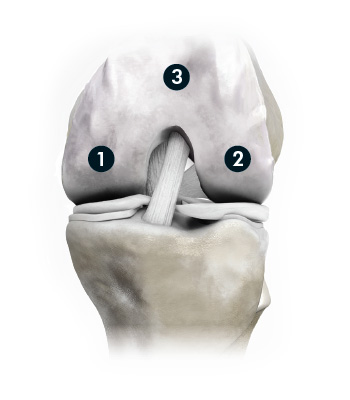
To understand the benefits of the ConforMIS personalized approach, it’s important to understand the anatomy of your knee.
Your knee joint is formed by the intersection of the femur (thigh bone), the tibia (shin bone) and patella (knee cap). These bones form three “compartments” or sections.
- Medial compartment (inner half of your knee)
- Lateral compartment (outer half of your knee)
- Patellofemoral compartment (behind the knee cap)
Osteoarthritis (OA) is a degenerative joint disease characterized by the breakdown and wearing away of cartilage causing the bones to rub together and result in pain. It can affect all of the knee or just parts, depending on the severity.
A partial knee replacement (PKR) is an option for people who have OA in one or two compartments. A total knee replacement (TKR) is an option for people with OA in all three compartments.
There Has to Be a Better Way
“Within four months I had two total knee replacements done, the ConforMIS way. It was made to fit my knee, not somebody else’s knee, not a guy’s knee, not another woman’s knee, and to me, that made more sense.” — Sue, bilateral iTotal® recipient
Knee replacement is a very common procedure. Despite its proven history, studies show that as many as 1 in 5 patients report they are not satisfied with the results of their total knee replacement.1
Knees vary in size and shape. Even your own two knees are different. In a traditional knee replacement, however, the surgeon selects an “off-the-shelf” implant from 6-10 standard sizes and makes the necessary adjustments to fit the implant during the procedure.
Because off-the-shelf implants aren’t designed to your specific anatomy, surgeons often have to compromise on implant fit, rotation, and alignment. These compromises can cause pain or discomfort after surgery and help explain why 1 in 5 patients aren’t satisfied.
The First Knee Replacement That Fits Only One Knee. Yours.
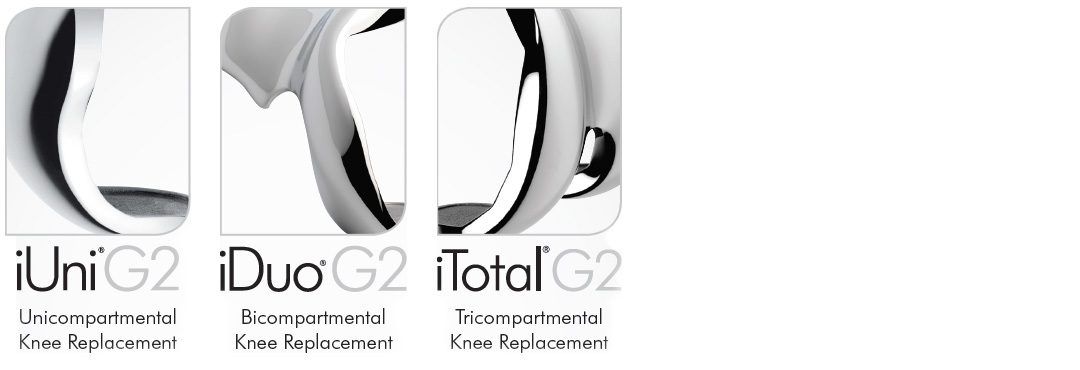
Making It Personal Instead of Off-the-Shelf
To provide our patients with better results, ConforMIS has developed the only customized total knee replacement that is designed specifically for your knee.
This patient-specific approach offers unique advantages not possible with traditional, off-the-shelf implants:
- Individualized fit that virtually eliminates sizing compromises common with off-the shelf implants and often associated with pain after surgery
- Designed to follow the shape and contour of each patient’s knee, which provides an increased potential for a more natural feeling knee
- Maintains the patient’s natural joint lines to avoid instability, a common cause of of patient dissatisfaction
Customized Fit
“I’m a metal fabricator. That means twisting, turning, and lifting every moment of the day. The ConforMIS partial knee replacement has made a huge difference in my life–at work and at home. I can even get on the ground and play with my grandkids again.” — Alan, iUni® recipient
Better Fit Leads to Less Pain
ConforMIS implants are specifically designed to fit your knee, avoiding sizing and positioning compromises common with off-the-shelf implants that can lead to long-term painful outcomes. Our implants are also designed for optimal bone preservation.
Customized Shape
“The biggest difference is the lack of pain, and my knee feels more natural. Even physical therapists are just astounded that I gained as much flexion and extension compared to the standard, off-the-shelf knee replacement.” — Rita, iTotal® recipient
Designed for a More Natural Feeling Knee
ConforMIS implants are designed to mimic the natural shape of your knee, which plays an important role in the way your knee bends and extends. By restoring the natural shape of your knee rather than replacing it with the standardized geometry of off-the-shelf implants, your knee may feel more like your natural knee.
Maintaining Joint Lines
“My knees feel completely natural. I would never think that there is a device in my knee because I do not feel any different on my right leg, which is the one that had surgery, than I do my left leg.” — Irene, iUni® recipient
Stability More Closely Matched to the Normal Knee2
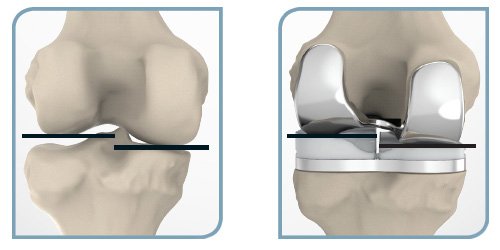
Many patients complain that their knee feels wobbly after knee replacement surgery. This feeling is formally known as mid-flexion instability. Off-the-shelf knee implants aren’t designed to match the natural offset joint line that most patients have. Instead, they flatten the offset to the same height, which can lead to mid-flexion instability.
ConforMIS implants maintain the patient’s medial and lateral joint lines, which allows for a more stable knee after surgery.
Customized Design
Customized Just for You
ConforMIS iFit® image-to-implant® technology converts a CT scan of your knee into a 3D model and then designs an implant that’s unique to you. This fully automated process ensures that your implant is made for your knee, and only your knee.
- Scheduling a CT Scan: Your doctor will give you a prescription for a diagnostic CT scan of your hip, knee, and ankle
- Getting Your Knee Scanned: The CT scan will be sent to ConforMIS
- Recreating Your Knee: Using your CT scan, a 3-D model of your knee is developed and will be used to individualize your implant
- Personalize Your Implant: Your implant and surgical instrumentation are designed and manufactured specifically for you
- Preparing for Surgery: Your implant will be delivered to the hospital a few days before surgery
1. Bourne, et al; Patient Satisfaction after Total Knee Arthroplasty. Who is Satisfied and Who is Not? Clinical Orthopaedics and Related Research; 2010, 468: 57-63
2. Patil, et al; Patient-Specific Implants and Cutting Guides Better Approximate Natural Kinematics than Standard Total Knee Arthroplasty. ORS Annual Meeting 2013, Vol.38. Abstract # 0965