
Knee
ConforMIS Personalized Partial Knee Implants
Not Everyone Needs a Total Knee
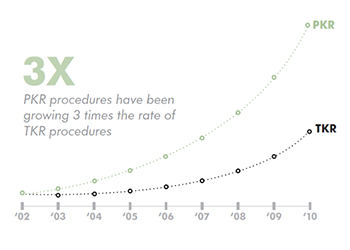
As patients get younger and more active, the interest in bone and tissue sparing partial knee replacement (PKR) has increased dramatically.
- More surgeons are recommending PKR
- PKR is a less invasive option compared to traditional TKR
- Higher patient satisfaction and better outcomes
Partial Knee Replacement
- 20-40% of all TKRs are performed on people who could have been treated with a partial knee replacement
- Patients tend to prefer UKA to TKA
- Preserves the ACL and PCL
- Preserves more bone and cartilage
- Less invasive surgery, less blood loss
- Smaller incision
- Faster recovery
- Disadvantage of partial knee replacement
- Has historically shown higher revision risk
- Potential for continued disease progression to other compartments
Unicompartmental Knee Replacement iUni® G2
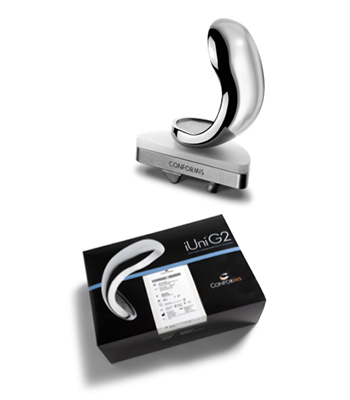
The only patient-specific unicompartmental knee replacement
- Designed to treat medial or lateral tibiofemoral osteoarthritis
- Provides a customized fit specific to your knee
- Designed to mimic the natural shape of your knee to help retain more of your natural function
- Allows for a less traumatic procedure and fewer bone cuts to preserve more of your natural knee for future treatment, if necessary
Bicompartmental Knee Replacement iDuo® G2
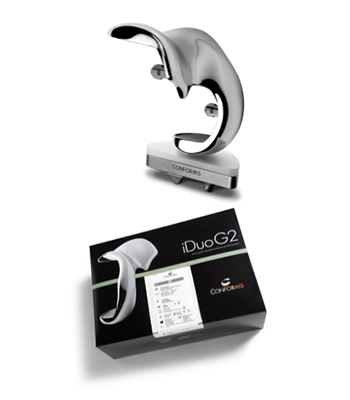
A revolutionary alternative to traditional off-the-shelf TKR
- Designed to treat medial or lateral tibiofemoral with patellofemoral osteoarthritis
- Combines proven TKR principles for patellofemoral treatment with the advantages of the ConforMIS partial knee system
- Treats just the affected knee compartments with a precise, patient-specific implant that delivers unparalleled fit, preserves all ligaments and conserves far more bone than traditional TKR